Quote first, then interpretation: how to structure the answer
Quote first, then interpretation helps show what the conclusion is based on. Let’s look at where this format is needed and how to use it without confusion.
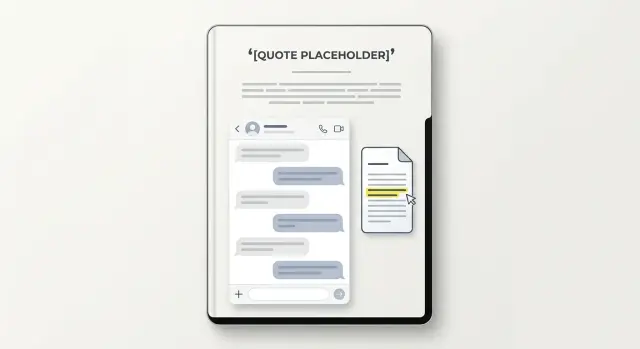
Why an answer without evidence is confusing
When a model jumps straight to the conclusion, the answer looks smooth and confident. But it’s hard for a person to see what it rests on: an exact line from the document, the general meaning, or the model’s guess.
Because of that, people start judging tone instead of facts. If the text sounds convincing, it’s easy to believe it even when the source says something slightly different. This is especially noticeable in documents where small details carry the meaning. One word like “only,” “except,” or “after approval” can completely change the decision.
Without a quote, the reader can’t see the most important things: which fragment the conclusion is based on, whether there’s an exception nearby, whether it’s a rule or just an example, whether the sentence applies to the current case, or whether the model mixed up two different paragraphs. Arguing with such an answer is almost blind. The user isn’t discussing the source; they’re trying to guess where the model went off track.
The problem often breaks ordinary work questions, not just difficult ones. A team asks an AI about an internal data retention policy. The document may say that personal data is stored inside the country, while anonymized technical logs are regulated separately. If the model answers, “Nothing can be sent outside the country,” it simplifies the rule and pushes the team toward extra restrictions, delays, and costs.
It’s worst when an inaccurate wording makes its way into an approval chain. A manager sees a short conclusion, forwards it, and after a few steps it starts living as a rule. Later it turns out the document had a caveat, but the decision has already been made.
That’s why the order “quote first, then explanation” is useful not for style, but for clarity. It shows where the fact ends and where the model’s interpretation begins. When the quote comes first, mistakes are often visible within half a minute. When the interpretation comes first, even a careful reader notices the substitution too late.
Where this order is needed most often
This format is needed where the cost of a mistake is higher than usual. If the model writes the conclusion in its own words right away, the reader doesn’t know what it’s based on. When the source fragment is visible first, checking and challenging it becomes much easier.
This matters especially in work answers that are later forwarded to a lawyer, doctor, insurer, compliance team, or manager. In these chains, people rarely read the whole document. They want to see the basis quickly and only then the interpretation.
This order is most often needed in three types of tasks:
- answers about a contract, offer, internal policy, security policy, or order
- answers about medical and insurance documents where one word changes the meaning
- answers for support, internal audit, approvals, or complaint reviews
With policies, the problem is usually the same: people remember the general idea but mix up the details. For example, the document may say that access to data is granted only after two approvals. If the AI writes, “One manager’s approval is enough,” the error looks plausible and easily spreads further. A quote before the explanation catches those mistakes almost immediately.
In medicine and insurance, this order is even more useful. These documents often contain terms with a narrow meaning: “covered,” “excluded,” “when clinically indicated,” “within 10 days.” If you first show the exact phrase and then translate it into plain language, a doctor, operator, or client can see more quickly where the fact ends and the conclusion begins.
A good example is an answer about an insurance rule. First, the system shows: “repeat diagnostics are covered with a referral from the treating physician.” Then it explains that the client is not denied completely, but payment depends on the referral. That kind of answer is calmer, more accurate, and easier to verify.
Support and audit also benefit from this approach. In support, an employee needs to answer quickly but without freelancing. In audit, it’s even stricter: it’s not enough to say “yes” or “no”; you need to show the clause that supports it.
For teams deploying LLMs in banking, telecom, government, or healthcare, this is no longer a style choice. It’s a way to reduce unnecessary approvals and cut down the number of answers that later have to be rewritten by hand.
How to structure the answer in two steps
If the answer needs to rely on a document, don’t start with a paraphrase. First give a short quote that directly answers the question. Then explain it in everyday language. That way, the person immediately sees the basis and doesn’t have to guess what is fact and what is the model’s conclusion.
The easiest way is to keep the answer in a simple structure:
- Pick a short fragment from the source that is closest to the question.
- Show the quote without decoration and without a long surrounding passage.
- Below it, give the interpretation in plain language.
- State the limitation separately if the source narrows the answer.
The quote should be short and precise. Don’t drag in a whole paragraph if the meaning is in one sentence. The less extra text there is, the easier it is to verify. If the document has no direct answer, it’s better to say that clearly than to assemble a conclusion from random neighboring phrases.
After the quote, the model can explain the meaning, but these parts need to be clearly separated. A simple pattern works well: first the source text block, then a “in plain words” paragraph. In the second part, you should also name the boundaries of the conclusion. For example, the document allows logs to be stored for 90 days. That is a fact from the text. But the phrase “so logs can be kept in any system” is already not a fact; it’s a conclusion, and it may be wrong.
The caveat is needed not for caution, but for accuracy. A source often applies not always, but only within one department, data type, or document version. If a policy is about employees’ personal data, don’t transfer it to customer data. If a rule applies only to systems inside Kazakhstan, that should be stated clearly too.
A short example: a team asks whether it can send a ticket description to an external LLM. First, the model quotes the policy line: “Before transferring data to external services, personal identifiers must be removed.” Then it explains that sending is possible if the system masks PII before the request. And it immediately adds a limitation: this conclusion applies only to tickets without attachments or document scans, because the source talks only about text fields.
That kind of answer is faster to read and easier to verify than a smooth but unsupported paraphrase.
How to show the quote so it can be checked quickly
When someone checks an answer, they’re not looking for a pretty fragment; they’re looking for the exact place in the source. That’s why a short quote is almost always better than a long half-page excerpt. If you take one paragraph with the key wording, the meaning is visible right away and checking takes less than a minute.
In this format, the quote should work as an anchor, not as background. To do that, it needs to be shown in the source’s own words. Don’t paraphrase the source inside the quote and don’t force the wording to match the style of the answer. Once you replace the author’s words with your own, checking has already turned into a debate about paraphrasing.
It also helps to show the reference point next to the quote. Usually the document name and section are enough. If there’s a clause number, it’s better to include that too. Then the reader doesn’t have to scroll through the whole file to find the right place.
For example, instead of this:
“The document says logs must be kept for a limited time and personal data must be protected.”
it’s better to write this:
“Request logs are stored for 90 calendar days. Personal data in the logs must be masked.” Policy “LLM Request Processing,” section “Log Retention and Audit,” clause 4.2.
In the second version, both the wording and the place to find it are clear.
What makes a quote easy to verify
Take only the fragment that directly answers the question, and leave the source’s wording as it is, even if the style feels dry. Label the document, section, and clause if there is one. If the idea depends on two places, show two separate quotes instead of one merged block.
That last point is often underestimated. When a team combines parts from different sections, the answer looks confident, but the reviewer can’t tell where one thought ends and the next begins. It’s easy to create the false impression that the source states the conclusion directly, when in fact it’s a combination of several places.
In internal policies, contracts, and regulations, this is especially noticeable. One clause may describe the retention period, another the exceptions, and a third the responsible employee. If you glue them into one “quote,” the reader won’t be able to quickly see what is written in each place.
If the document is long, don’t try to show everything at once. It’s better to give one exact fragment and briefly explain its meaning below. That order is more honest and more convenient.
Example with an internal policy
A support employee asks whether a customer call recording can be kept after the case is closed. If the system immediately says “yes” or “no,” the employee will still go back to the document. Without the policy text, it’s hard to trust that answer.
Here, a two-step answer works better. First, the system shows the exact fragment from the internal document. Then it explains it in plain language and doesn’t pass a guess off as a rule.
“The company stores recordings of phone calls with customers for quality control and complaint handling for no more than 90 calendar days. Employees do not share recordings with third parties unless required directly by law or a separate internal procedure.”
After the quote, the system can answer like this: the recording may be kept if the purpose is quality control or complaint handling, and if the retention period is no more than 90 days. The recording cannot be shared with an outside contractor unless the policy or a separate procedure clearly allows it. If the employee wants to keep the recording “just in case,” the text does not allow that.
It also helps to show clearly what the document does not say. This is where teams often make mistakes and fill in the rule themselves. For example, the quote does not tell us:
- whether a transcript can be kept under the same conditions as the audio
- whether an external CRM counts as a third party
- what to do after 90 days: delete the recording, anonymize it, or move it to an archive
If the document is silent, the system should say so: “Clarification is needed from compliance or the policy owner.” That is better than a polished but risky answer. For teams working with customer data, this format noticeably lowers the chance of a disputed interpretation.
Where teams most often go wrong
When a team implements an answer based on a source, it often breaks the simplest logic: the model gives a long conclusion first and hides the quote below. The reader has already seen the interpretation, but still doesn’t know what it rests on. Checking takes longer, and it’s harder to argue with such an answer than with a short quote and a clear explanation.
This usually happens with good intentions. The team wants the answer to sound smooth and “human,” so it puts the friendly paraphrase first. But in disputed areas, especially policies, contracts, and internal rules, smoothness just gets in the way. If the basis isn’t visible right away, the answer loses trust.
The most common mistakes are:
- a general conclusion appears first in several lines, and the source fragment comes later
- the system takes too broad a passage, where the topic is there but not the exact wording, deadline, or exception
- the team calls a paraphrase a “quote” even though the source’s wording has already changed
- limitations like “except,” “no later than,” “only if,” or “after approval” disappear from the answer
This is very easy to see in internal documents. Suppose an employee asks whether training can be reimbursed. The policy says: “The company reimburses training after approval from the manager and within an annual limit of 150,000 tenge.” A bad answer sounds like this: “Yes, the company reimburses training.” The topic is right, but the meaning is already damaged. The approval and the limit are gone.
Another common mistake is choosing a fragment that’s too general. The model finds a paragraph about “employee learning and development” and builds the answer on that, even though the exact rule is lower down in a short line with the amount and conditions. The general fragment looks solid, but it doesn’t help much.
Using a paraphrase instead of a quote is an even bigger problem. If the model changes “may be approved” to “is allowed,” it removes the degree of uncertainty. In everyday conversation, that’s minor. For checking a policy, contract, or law, it’s a different rule.
A good test is very simple: remove the interpretation and keep only the quote. If the answer can’t be verified quickly from that alone, the team picked the wrong fragment. If the rule is visible but the limitations are not, then the team cut out the most important part.
Quick check before launch
Before launch, ask one uncomfortable question: can the user understand for themselves what the conclusion is based on. If not, the format is still rough. This answer only works when the support is visible right away, not hidden at the bottom or moved to a separate window.
Open the finished answer and look at the first lines. The user should immediately see the source wording and only after that a short explanation in plain words. If the paraphrase comes first and the quote appears later, the person can mistake the interpretation for a fact.
It helps to separate fact and explanation clearly. Even a short structure is enough:
- first, the exact source fragment
- then, an explanation without new facts
- then, if needed, the conclusion for the specific situation
That is often enough to remove half the disputes before launch. The user sees where the document speaks for itself and where the system is making a conclusion.
There is a second useful test as well. Give the answer to someone who wasn’t involved in setup and ask them to check the conclusion without help from the team or a developer. If they ask, “Where did this come from?” or “Where is that written?”, the format didn’t pass the test. A proper answer can be checked in a minute: read the quote, compare it with the explanation, and see whether the meaning drifted.
What usually breaks
Problems are easiest to see on disputed questions. When the request is simple, almost any template looks neat. The difficulties begin where the source is ambiguous, outdated, or allows two readings.
So check cases where the rule depends on an exception, the document contains similar wording, the user wants a definite conclusion while the source is more cautious, or the quote is long and tempting to shorten too much.
If the format starts mixing the quote and the interpretation in such examples, it’s too early to launch. It’s especially dangerous when the system cuts a sentence so that the condition, deadline, or limitation disappears.
A small example: the company policy says, “Remote access is approved for employees with a project need.” If the answer says, “Remote access is allowed for employees,” it already loses the meaning. The user should first see the full wording and then the explanation: access is possible, but not for everyone and only after approval.
For teams deploying such answers in working systems, it’s also useful to check one more thing: does this order stay stable under load, in long conversations, and with vague questions. If the format sometimes jumps straight to the conclusion, trust in it drops quickly. One disputed answer is remembered better than ten careful ones.
What to do next
Don’t change the answer format across the whole product all at once. Start with 3–5 scenarios where a mistake is costly or quickly causes a dispute. Usually these are questions about internal policies, contract terms, pricing, approval rules, and operating instructions.
Then compare two approaches on the same set of questions. The first is the usual answer without source support. The second follows the pattern: first quote, then short interpretation. The difference shows up quickly: in some cases the second format is a bit longer, but it’s easier to check and there are fewer disputed interpretations.
It’s better to use real team questions, not invented examples. If employees often ask, “Can we share this type of data with a contractor?” or “Who approves this payment?”, test those exact wordings. That way you’ll find out faster whether source-based answers really help in day-to-day work.
To keep the pilot from dragging on, a short plan is enough:
- choose a few frequent, high-risk scenarios
- collect 20–30 real document-based questions
- run them in the old format and in the “quote + interpretation” format
- note where the employee could verify the answer within a minute
- record which template led to fewer disputes and follow-up questions
After that, lock the template in two places at once: in the prompt and in the interface. If you leave the rule only in the prompt, the model may sometimes shorten the answer or reorder the parts. If you add the same structure to the interface, it becomes easier for the user to read the answer: first the basis, then the conclusion.
The template itself doesn’t have to be complicated. Often three blocks are enough: “Quote,” “What it means,” and “If the document has no direct answer.” The last block is especially useful: it stops the model from making things up when the text is silent.
If the team compares several models through a single API gateway, this test is faster. For example, in AI Router on airouter.kz you can run the same set of questions through different OpenRouter-compatible models via one OpenAI-compatible endpoint and look not only at the quality of the interpretation, but also at how consistently each model keeps the source-based format. That’s useful when you’re choosing not the most talkative model, but the one that cites carefully and guesses less often.
That’s usually enough to make a decision within a week. Not about which model sounds more confident, but about which answer format people actually check and use without extra back-and-forth.
Frequently asked questions
Why shouldn’t the answer start with the conclusion?
Because the reader sees a confident statement but not the evidence behind it. If you show the exact line from the document first, it becomes much easier to spot a mistake, a missed exception, or an overgeneralization.
Where is the quote-first, explanation-second format used most often?
Primarily where a mistake quickly turns into a bad decision: in policies, contracts, security rules, medicine, insurance, and approvals. In these topics, one word like “only” or “after approval” can change the meaning completely.
How long should the quote be?
Take only the fragment that directly answers the question. Usually one or two sentences is enough: a long passage slows down checking and hides important conditions.
Can I rewrite the quote in my own words?
No, it’s better not to. As soon as you change the author’s words, checking turns into a debate about paraphrasing, not the document. First give the exact text, then explain it in simple language in a separate paragraph.
Should I include the section and clause of the document?
Yes, that helps a lot. The document title, section, and clause save time: the reader doesn’t have to search through the whole file and guess where the answer came from.
What should I do if the document has no direct answer?
Write that directly. It’s better to honestly say the document does not give an exact answer than to build a conclusion from nearby phrases and present a guess as a rule.
How do I avoid losing exceptions and limitations?
Show the limitation right after the explanation. If a rule applies only to one data type, department, or time period, name that clearly so the reader doesn’t apply it to a different case.
What if the answer relies on two places in the document?
Don’t merge them into one “quote.” Show two separate fragments and briefly explain how they relate, otherwise the answer will look like the document is stating the final conclusion all at once.
How can I quickly test this format before launch?
Give the answer to someone who did not set up the system and ask them to check it in a minute. If they immediately understand where the quote is, what it means, and where the limits are, the template works.
Where should a team start when implementing this?
Start with a few risky scenarios and real team questions. Compare the standard answer with the quote-plus-interpretation format on the same set of queries and see where people argue less and check faster.