API Change Log for LLM Providers Without Production Breakages
An API change log helps you spot new fields, limits, and method removals in time so you can verify integrations before production breaks.
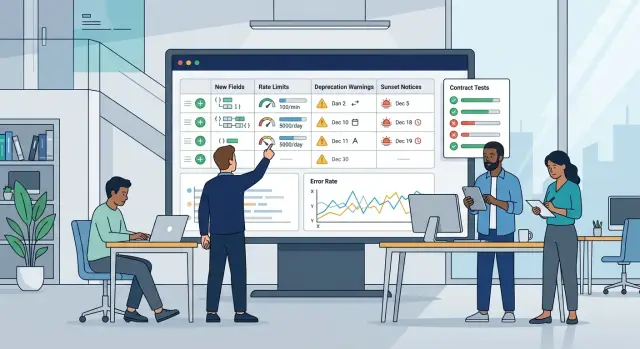
Why failures are noticed too late
Breakages almost never happen on the day of the announcement. They show up later, after the new behavior has already reached production traffic. In the test environment, the team usually runs a few familiar scenarios. In production, requests behave much more broadly: streaming mode changes, a rare model appears, context grows, tool calling is enabled, and a retry after a timeout kicks in.
Because of that, the basic checks stay green while the rare path breaks. For example, chat works fine, but a request with a function fails after the provider adds a new field, changes a value type, or lowers the response-size limit. The user sees the error first, even though the team looked at a “successful” test run that morning.
Change signals also rarely live in one place. An email lands in a shared inbox, one person reads the release notes, and a chat message quickly disappears among releases and on-call work. A week later, nobody remembers that the provider planned to remove an old method or change a parameter’s behavior. The news turns into a future incident instead of a task.
The problem gets worse because of dependency chains. A small response change rarely affects only one place. If a field becomes nullable instead of a string, the parser fails first, then the mapping in the orchestrator breaks, then metrics drift, and after that analytics starts counting some requests as failures. One small change pulls several services with it.
This is especially visible in LLM integrations, because teams often work with several providers and models at once. Even if your input is one and the same, differences surface in real parameter combinations. That is why an API change log is not about keeping documents tidy. It is there to connect the announcement, the owner, the risk, and the verification date before the error reaches the customer.
Which changes break integrations most often
Most integrations are broken not by large releases, but by small contract changes. Yesterday the request went through; today the same JSON gets 400 or 422, and the team only sees the problem through production errors. The change log is not for archiving. It serves a very practical purpose: to quickly understand what exactly became different.
The most common case is when a provider makes a field required. Requests that used to work with a sensible default start failing until you add the new parameter. This is especially painful in a setup where the same code goes to several APIs through a shared layer.
A change in the type or format of a familiar field causes just as many problems. A number becomes a string, a timestamp arrives in Unix time instead of ISO, or an array turns into an object. On paper, the change is tiny. In code, it breaks validation, serialization, or response parsing.
Limits are another common pain point. A provider may lower the maximum number of tokens, RPM, file size, or concurrent requests. The code did not change, but the queue grows, some calls get 429, and others get truncated.
Another frequent scenario is API method removal. The old path is marked as deprecated, then it is closed completely and the call moves to a new endpoint with a different request body. If the team does not track changes in one place, someone only finds out after a night release.
Error handling changes too. The status code may stay the same, while the message changes. Or the other way around: you used to catch 429 and read retry-after in seconds, but now the provider returns a different field, a different format, or moves the hint to a header. After that, retries work worse and create extra load on their own.
If you already have contract tests, check at least five things: required request fields, types and formats of familiar fields, token and frequency limits, the current path and method version, and the error code together with retry-after. Even that short list catches most breakages before production.
What to record in the change log
A log entry should answer one question: what exactly changed, and where will it hit? If you leave a vague line like “the provider updated the API,” the team will not understand anything until the first production failure.
A good change log is less like a news diary and more like a working risk card. From it, a developer, tester, and service owner can immediately see what to check, by when, and who is responsible.
What every entry should include
It is best to keep the minimum set of fields the same for all providers and models:
- the date the team noticed the change and the signal source: changelog, email, ticket, chat
- a short description of the change: a new field in the response, method removal, a new header, a different limit, model name change
- the list of affected areas: services, SDKs, background jobs, prompt templates, retry settings, and rate limits
- the effective date and the name of the person who owns the task until it is done
- the verification that proves the risk is gone: a contract test, smoke test, or a manual run in the staging environment
That is already enough not to lose the details. If a field became required, the entry should name the field and say which requests will fail without it. If the provider lowered a limit, write down the old and new values instead of just noting that “limits changed.”
It also helps to record behavior changes. For example: “temperature is now ignored for this model” or “streaming requires a new header.” Formally, the API may still answer 200 OK, but the product will behave differently. These quiet changes often cost more than obvious errors.
For teams that go through several models via one OpenAI-compatible gateway, this matters even more. Even with a single entry point, changes come from different providers. That is why the entry should record not only the external route, but also the exact model or provider where the shift was found.
A small example: a provider announces that the old embeddings method will be removed in 30 days. In the register, it is not enough to write “deprecated.” You need specifics: which services still call this method, which SDK uses the old path, who is moving calls to the new method, and which test will run the requests before and after the switch.
If any engineer understands the risk in a minute after reading the entry, the format works. If they have to go into chat and ask five follow-up questions, the entry is still too rough.
Where to get update signals from
Almost nobody notices an API change at the moment of release. Usually the team sees it later: through a rise in 4xx, empty fields in the response, or a sudden hit against limits. That is why it is better to feed the change log from several sources at once.
The first layer is the provider’s official changelog and SDK release notes. The provider may not change the route itself, but it may add a required field, rename a parameter, or remove an old method in a new client version. If the team updates the SDK automatically and nobody reads the notes, the failure comes quickly.
The second layer is automated contract checking. Compare OpenAPI, JSON Schema, or at least response examples between yesterday’s and today’s version. This kind of diff often catches what people miss at a glance: a new enum value, a missing usage field, a different error format, or a new input size limit.
It also helps to look at service headers. That is often where the first signs of trouble appear: deprecation if the method has started to be retired, sunset if there is already a shutdown date, new headers with limits, request-id, and version warnings.
Documents alone are not enough. A short daily check on a test project gives a more honest signal. Five to ten short requests are enough for the most important scenarios: normal chat completion, streaming, tool calling, embeddings, and a large prompt at the top of the limit. If even one test changes status, response schema, or waiting time, an entry should go into the register that same day.
Another source many people underestimate is support and your own incidents. If an engineer once learned through support that the provider lowered RPM for a new plan, that should not stay in email. The same goes for internal postmortems. A production error often points not only to a code bug, but also to a missed signal.
How to build the process step by step
Without an owner, the register quickly turns into a pile of notes. You need one person who watches the format of entries, checks new changes, and reminds the team about deadlines. That does not mean they do all the work themselves. They just keep things organized.
Next, bring all providers into one template. If one changes a response field and another removes an old method, the team should see both in the same way: what changed, where it is affected, when it takes effect, who is responsible, and what risk it brings. Then the entries are easy to filter by service, risk, and date.
It helps when each entry has six simple items: provider and method, type of change, affected service or scenario, the test that will catch the failure, the response deadline, and the owner. That is enough for day-to-day work.
Attach an action to each entry right away. If the provider raised the token limit, that is not just a note. Someone should check retries, quotas, and budget. If a method was marked deprecated, the team sets a replacement deadline and adds a test that fails before the production release, not after it.
Alerts should be short. One message, one risk, one deadline. Long summaries stop being read very quickly. It is better to notify only the services affected by the change.
Once per sprint, the register owner gathers overdue items and reviews them with the teams. The question is simple: close it, move it with a clear reason, or raise the risk. Otherwise, the register becomes an archive.
A real release example from a team
A team has a support chatbot. It calls an external LLM provider through a familiar SDK. The Friday release looked normal: they updated a dependency, ran short scenarios, and rolled it out to part of the traffic.
Everything looked fine in staging because the tests only checked two or three short replies. But that same day, the provider changed the name of one field in the response and lowered the allowed max_tokens. Short conversations still passed, but longer chains with history no longer did.
The problem surfaced in the evening. A user reached the fifth or sixth message, the request grew, and the API started answering 400. The on-call engineer saw a spike in client errors, but first followed the wrong lead: they suspected the new prompt and a recent frontend release. The logs only showed bad request, while the real cause was hidden in the changed contract.
If the team has a change log, the picture comes together faster. It records not only the update itself, but also small shifts: field renames, new required parameters, old limits, and the date when they changed. Then the rise in 400 can be linked immediately to a specific change instead of guessing between several versions.
A contract test in staging would have done even better. It performs two simple checks: sends a long conversation with history and verifies the exact response shape. Such a test would have caught both failures before rollout: the parser would not find the field under its old name, and the request for a long response would hit the new max_tokens limit.
After that, the team would not have been searching for the cause in production. They would have seen the failure in staging, updated the field mapping, lowered the limit or added history trimming, and only then released the change.
These breakages seem small until the first evening incident. One unnoticed contract shift can easily turn a quiet release into an hour of manual diagnosis, a rollback, and a queue of unhappy users.
How to check risk before rollout
Reading the changelog is not enough. You only see the risk when you run the same set of requests through the old and the new version and compare the result in facts.
Start with a production baseline: normal requests, your longest prompts, tool calls, attachments, and streaming. If you have a register, add a check for each change that catches exactly that class of failure.
What to run before release
Contract tests should look at more than just status 200. They should verify the response shape: required fields, types, nested objects, finish_reason, usage, tool call format, and chunk order in streaming.
A useful minimum before release looks like this:
- compare the old and new response on the same set of requests and note fields that disappeared, were renamed, or became
nullable - check long requests near the token limit to see early cutoffs, truncation, and changes in error codes
- run file, image, or audio scenarios separately if your application uses them
- compare timeouts,
429,5xx, error text, and retry rules so you do not create a retry storm - measure latency and cost on the same traffic, because a more expensive route does not always bring visible value
Teams stumble on errors more often than on normal responses. One provider returns 400, another 422, and a third returns 429 with a different header for backoff. If the client expects the old behavior, it will either start losing requests silently or loop retries.
After the test run, you need a small canary in live traffic. Usually 1-5% of requests is enough on a segment without the most sensitive operations. Watch at least three things: failure rate, p95 latency, and cost per request or per 1k tokens. It also helps to track the share of empty or cut-off streaming responses. If even one metric moves outside your normal range, it is better to stop the release and write the finding into the register right away.
Where teams go wrong
Teams usually break integrations not on a big release, but on small things that nobody kept under control. A new field in the response, a different limit, an old method being removed — and all of that lives in notes, chats, or personal documents. If the register has no owner, it quickly becomes a useless archive.
A common mistake is looking only at the SDK. The package may update cleanly, while the API itself already behaves differently: it asks for a new parameter, changes the error format, truncates the stream, or returns a different status. The team sees that the build passed and relaxes too early. Then the failure comes from production traffic, where requests are longer and load is higher.
Another miss is writing a vague deadline like “move by the end of the month” and not listing exactly what is affected. That is how background jobs, old microservices, reports, internal bots, and rare routes get lost. One service is updated, two are forgotten, and then 404 lands at night on a method that “almost nobody uses.” In practice, those forgotten pieces are the first to fail.
Rare scenarios are also often skipped. The team checks a short request with a typical response and considers the job done. But the problems are usually elsewhere: a long response hits the new limit, streaming arrives in a different format, a retry request hits 429 earlier than expected, an empty or partial response breaks the parser, or an old method still works in test but has already been removed for part of the keys.
Because of this, contract tests easily give a false sense of safety if they do not include long responses, rare parameters, and failures under edge load.
A quick weekly check
A weekly check is not for bureaucracy. It is there so the register does not turn into an archive that nobody opens until the 4xx and 5xx traffic spikes.
Usually 15 to 20 minutes is enough. Open a short table and go through what is already in production: which providers are active, which models are actually receiving traffic, and which of them changed last week. If a model has not been touched in a while, that is not a reason to skip it. Old methods often disappear quietly.
You can follow a simple checklist:
- Match the list of providers and models against real traffic. Only integrations that truly run in production should remain in the table.
- Check the last verification date for each entry. If there is no fresh date for a provider, treat it as a risk zone.
- For each risk, keep one clear test and one deadline. For example: “check that
chat.completionsstill accepts the old field until Wednesday.” - Review alerts for
4xxand5xxby provider. A rise in404,422, or429often points to a schema, limit, or quota change before the team reads the release note. - Clarify who makes the decision today: roll back the release, switch traffic to another model, or temporarily disable the disputed route.
After that check, the list of problems is usually short. One risk goes into tests, another into a client update task, and a third into a fallback plan. If a risk has no deadline and no owner, it will almost certainly show up in production.
A simple example: a team uses two models from different providers for chat and classification. One has a rise in 429, while the other has a method marked for removal in a month. Over the week, that is visible both in monitoring and in the register. The team sets a deadline for contract testing, prepares a fallback route, and decides in advance who will give the switch command if the error repeats.
What to do next
Start with one shared document for the whole team. When every service keeps its own list separately, changes get lost between people and releases. One register works better: it shows the verification date, affected provider, risk, owner, and what needs to change in the code.
Do not try to cover every call at once. Take the two or three most important scenarios and verify them with contract tests. Usually these are the chat response, streaming, and embeddings, but the set depends on the product. These tests should catch new fields, missing parameters, different error codes, limit changes, and method removals.
If the team works with several providers, do not push their quirks deep into the application. One compatible layer significantly lowers the risk: you change the rules in one place instead of hunting for differences across dozens of services. If you already use a single gateway like AI Router with an OpenAI-compatible endpoint, keeping such a register is easier: there are fewer separate entry points, and it is clearer which route, model, and test are tied to the change.
Once a month, it helps to do a short review using one template. You do not need a big meeting or a separate project. Half an hour is usually enough if you only look at what actually breaks production: token, RPM, TPM, and concurrent-request limits, new required fields, response format changes, announcements of method removal, and a fallback route for 429, 5xx, or a missing model.
This rhythm pays off quickly. After a month, the team already has a change history, clear tests, and fewer urgent fixes before rollout. A good first step this week is to create the register, assign an owner, and add the three scenarios the business cannot afford to lose even for an hour.
Frequently asked questions
Why do we even need an API change log?
The register links a provider announcement to a specific risk, deadline, and the person who will verify the change. Without it, the team reads the news separately and only sees the failure later through 4xx, 429, or user complaints.
Which API changes break integrations most often?
The most common breakages come from small contract changes: a new required field, a type change, a different error format, a new token or RPM limit, or an old method being removed. Big releases are easier to notice, while these small shifts often slip through until production traffic hits them.
What should go into one register entry?
Keep the date, the signal source, what changed, which services or scenarios are affected, when the change takes effect, who owns it, and which test removes the risk. Be specific: not "limits changed", but the old and new values.
Who should maintain the register on the team?
Assign one owner for the register. They do not fix everything themselves; they make sure the entries are complete, the deadlines are not missed, and the team does not forget to verify things before release.
Where should we get update signals from?
Use the provider changelog, SDK release notes, schema or response diffs, service headers like deprecation and sunset, and also your own incidents and support conversations. One source almost always misses part of the story.
Which tests should we run before release?
For a start, a short set is enough: a normal chat request, streaming, tool calling, embeddings, and a long prompt near the limit. Look not only at 200, but also at the response shape, usage, finish_reason, error codes, and retry-after.
How often should the register be checked?
Check the register at least once a week and update it the same day you find a new signal. If an entry sits there without a fresh date, an owner, and a test, treat it as an open risk.
What should we do if a provider marks a method as deprecated?
Do not wait until the shutdown date. First find every service that still calls the old method, set a migration deadline, add a test for the new path, and decide who will call rollback or switching if the replacement goes badly.
How do we notice silent changes if the API still returns 200?
Compare the old and new response on the same set of real requests. If the API still returns 200 but a field became nullable, streaming changed chunk order, or the model started ignoring a parameter, that diff will catch the problem before the user does.
Does a single OpenAI-compatible gateway reduce breakage risk?
Yes, the risk usually drops because the team maintains one compatible layer instead of a set of separate integrations. That does not replace the register or tests, but it makes routes, models, and contracts much easier to check in one place.